
“Feedback is a classic double-edged sword. If done properly, feedback has enormous benefits for both parties involved. But the other side of the sword is that when not done properly, it has negative effects.” —Jack Zenger & Joe Folkman
When you hear the word feedback, what comes to mind?
As leaders, we know feedback is important for a team to function—but at the same time, giving and receiving feedback doesn’t always come naturally.
Sometimes we may struggle to give honest feedback because we worry about discouraging our team. Other times, we may dread being on the receiving end.
In these scenarios, the tendency is to stay quiet. The brain starts rationalizing…
➡️ “I won’t mention this because I don’t want to hurt their feelings”
➡️ “I’m afraid to ask for feedback, because what if it’s actually bad?”
➡️ “It’s not a big deal and I don’t want to bother anyone, so I’ll just fix it myself.”
Ironically, silence often leads to conflict. When feedback goes unsaid then misunderstandings snowball, expectations aren’t met, and frustration builds.
But when done well, feedback becomes an important part of workplace communication that can benefit everyone involved.
Reframing Our Thoughts on Feedback
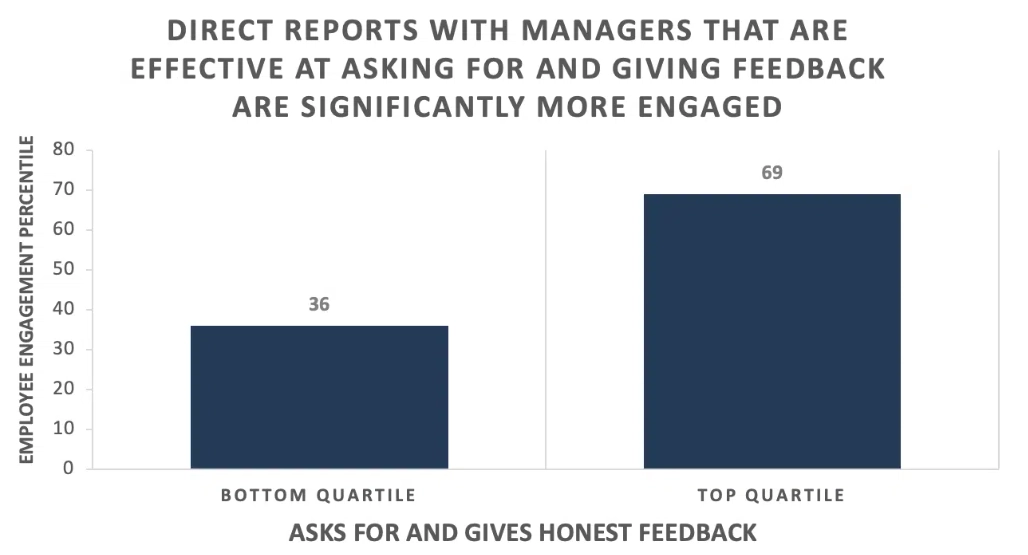
A few years ago, leadership consultants Jack Zenger and Joe Folkman conducted a study involving 3.422 managers. Based on 360-degree assessments, they rated each manager based on their effectiveness at asking for and giving honest feedback.
Then they assessed the engagement levels of those managers’ reports.
The correlation was huge. Employees with top-performing managers ranked in the 69th percentile for engagement, compared to the 36th percentile for employees with the lowest-performing managers.
The connection here shouldn’t be surprising.
Feedback is a flow of information between managers and reports. So what may feel like a feedback problem is fundamentally a communication problem.
➡️ Lack of feedback = lack of communication.
➡️ Unclear feedback = unclear communication.
➡️ One-sided feedback = one-sided communication.
When workplace communication is vague or one-sided, employee engagement tends to be low. When communication is clear and frequent, employees are usually more engaged and perform better in their roles.
When you reframe feedback within this context, it no longer feels like an icky subject that everyone needs to tiptoe around. And it becomes a natural part of workplace interaction.
4 Tips for Creating Healthy Feedback Culture
A healthy feedback culture is one where feedback is a tool for support and collaboration, not something to fear. Team members feel comfortable both giving and receiving feedback, and know how to offer it in a way that’s constructive, not critical.
It can take a while to cultivate this environment, especially if your team members have an aversion to feedback or see it in a negative light. Patience is key.
These are some steps that you can start practicing right away to reduce the stigma and start building a healthy feedback culture:
- Focus on the positive, not the negative. Zenger and Folkman suggest the ratio of positive to constructive feedback should be proportional to the ratio of good work to work that needs improvement. For example, if 90% of work is strong and 10% needs improvement, feedback should be 90% positive and 10% constructive. This will keep employees from feeling like their shortcomings are recognized more than their strengths.
- Seek opportunities to both give positive feedback and ask for feedback throughout your day. For example, after giving a presentation or concluding a project, you can ask each member of your team for one suggestion on how you can improve. Or when an employee brings up a good point in a meeting, a simple acknowledgement and thank you can motivate employees to volunteer more ideas.
- Offer positive feedback for requesting feedback. As clumsy as it sounds, expressing appreciation when a team member asks for feedback creates a culture in which the process is encouraged. Likewise, it’s important to express appreciation for the feedback you receive.
- Communicate clearly and ask clarifying questions. Vague feedback can sometimes be worse than no feedback. Always try to be clear and create space for people to ask questions if something doesn’t make sense.
As team members learn to give feedback with clarity and confidence, both team relationships and performance improve. They can help each other identify strengths and weaknesses, work more collaboratively, and discuss issues before they snowball into large conflicts.
We all have lessons to learn from others—and experiences worth sharing in return.
That’s how individuals grow, and how teams get stronger.